Since the origin of time, communication has always been humanity’s key element in advancement. From the Khoi San and ancient Greek, to the Egyptian Hieroglyphics all the way through to the modern-day cell phone – the evolution of communication has always been a distinguishable component to human civilization. As of today, communication has evolved to what we know as the Digital Era. Digital Marketing and Digital Communication are so emphasised in our daily lives, we barely notice them. i.e. You decide to learn about a skill on how to trade online. You open YouTube and you watch a 3-hour video about all the trading strategies. Throughout the video, 8 short adverts of an online trading brokerage app play. As the millennials, we barely pay any attention to the adverts, however, due to the constant repetition, we will not forget it. Thus, once you have finished the video of learning to trade, you most likely download the app that has been advertised.
Below are the top 5 uses of digital communication and digital marketing:
- Artificial Intelligence
AI, or Artificial Intelligence, is one of mankind’s greatest creations. It is not just robots as seen in the movie Terminator where they try and ensure the extinction of humanity. But more along the lines of responsive robotics. There are many types of AI, namely: Reactive, Limited Memory, Theory of Mind, Self-aware, Artificial Narrow Intelligence (ANI), Artificial General Intelligence (AGI) and Artificial Superintelligence (ASI). (Joshi, 2020) AI can analyse consumer behaviour and search patterns and use data from social media platforms and blog posts to help businesses understand how customers find their products and services. (Dave, 2020). i.e. Microsoft and Uber use an AI robot known as Knightscope K5 Robots to patrol parking areas to prevent and predict crime. The robot can identify number plates, report suspicious crime as well as report the data that has been collected to their owners. (Dave, 2020)
- Programmatic Advertising
This form of digital marketing uses artificial intelligence in the advertising industry. This means that customers can purchase the advertising and the AI will automate it so you can target more specific audiences. A diagram of the system is shown below: (Dave, 2020)
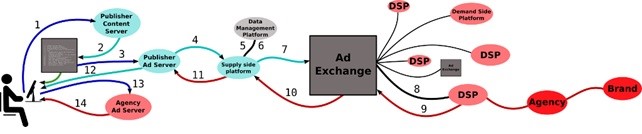
(How Programmatic Advertising Works – Chase Software, 2020)
- Chatbots
Chatbots are an AI type system that uses instant messaging. This improves relations with customers and can resolve inquiries, almost instantly. i.e. Messaging a company to inquire about a link to a webinar. The bot will constantly be friendly with you, ensure good relations and provide you with the details of the inquiry. This is of course programmed inside the software. (Dave, 2020)
- Personalisation
A method of advertising that empowers the customer and ensure they are important to the business and its brand. It improves customer relations by providing them with an unforgettable experience i.e. Starbucks with their personalised name cups, or a simple email but including the customer’s name, instead of To Whom It May Concern. (Dave, 2020)
- Influencer Marketing
This type of marketing is used by highly influential people in society. Their promotion to society has a vast and great impact and can determine the “make it or break it” of the product or service, and the business as a whole. (Dave, 2020) i.e. Jeffree Star and Shane Dawson’s make-up pallet inventory was fully sold within a day of the launch. This is as a result of a years’ worth of planning, and several weeks of aggressive advertising on their YouTube channels which inform more than 8 million people globally.
REFERENCE LIST
Chase Software. 2020. How Programmatic Advertising Works – Chase Software. [online] Available at: <https://www.chasesoftware.biz/how-programmatic-advertising-works/> [Accessed 23 May 2020].
Dave, N., 2020. 42 Digital Marketing Trends You Can’t Ignore In 2020. [online] Single Grain. Available at: <https://www.singlegrain.com/digital-marketing/digital-marketing-trends-2020/> [Accessed 25 April 2020].
Joshi, N., 2020. 7 Types Of Artificial Intelligence. [online] Forbes. Available at: <https://www.forbes.com/sites/cognitiveworld/2019/06/19/7-types-of-artificial-intelligence/#3f157012233e> [Accessed 25 April 2020].


